Roger van Klaveren
“They gave me a life back”
Roger van Klaveren survived sepsis after a ruptured intestine in 2023. He fought for his life for weeks and lost both lower legs and parts of his fingers. Today, he continues his journey, campaigns for more knowledge about sepsis and wants to encourage those affected with his story.
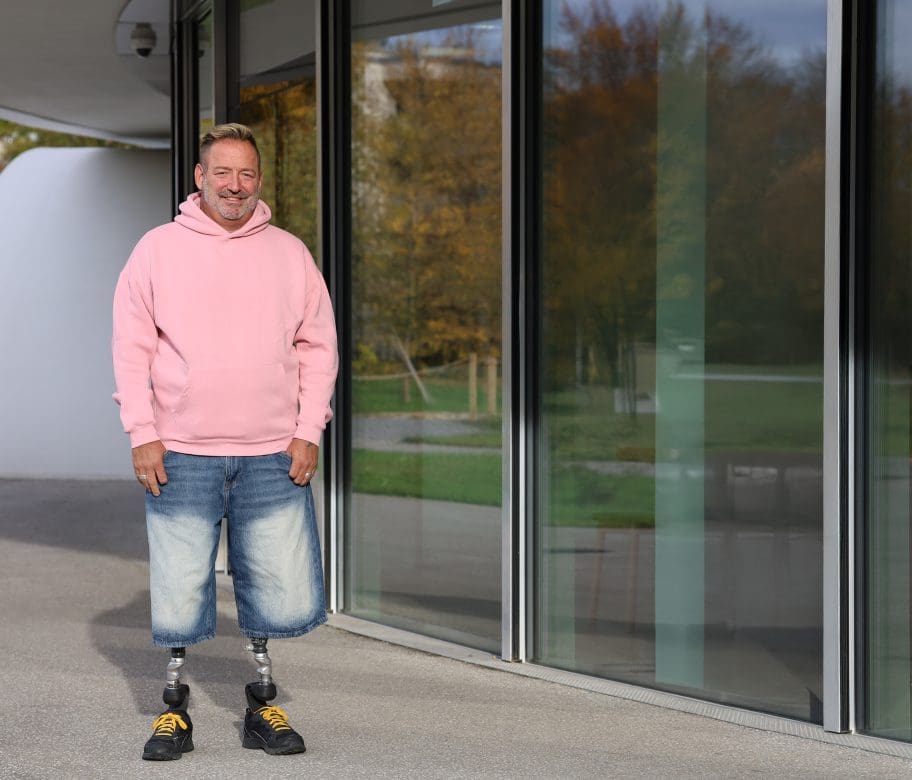
In spring 2023, Roger van Klaveren felt increasingly ill for two weeks. At the time, the all-rounder was working as a landlord in Basel and trying to get on with everyday life. But one Sunday at the end of April, he suddenly noticed that his body was no longer cooperating. “At first I thought it would go away, but when I could no longer bend over, I knew something really bad was going on.” He went to hospital, where he was kept for further treatment and monitoring.
He has no memory of anything that happened afterwards. He only knows what happened to his body and during the treatments from the stories he told afterwards. He suffered a ruptured bowel. The doctors tried to repair the intestine, but it had already died. This was followed by multiple organ failure: the kidneys stopped functioning and could no longer cleanse the blood. A dialysis machine therefore had to take over this task. He was fitted with a stoma, an artificial small bowel outlet. And he was put into a coma. For four weeks, he hovered between life and death.
Severe consequences of sepsis
Als er das Bewusstsein wiedererlangte, war bereits klar, wie gravierend die Schäden waren. Die Sepsis hatte seine Durchblutung massiv beeinträchtigt. Gegen Ende Mai wurden beide Unterschenkel amputiert. Später folgte die Teilamputation von insgesamt fünf Fingern. Während der gesamten Zeit lag Roger van Klaveren auf der Intensivstation. Anfangs wurde er mit einem Schlauch beatmet und konnte nicht sprechen. «Viele konnten meine Lippen nicht lesen. Das war extrem schwierig für mich», sagt er.
Between intensive care, delirium and painful positions
After the intensive care phase, he was transferred to the normal ward. He could hardly move. Due to a painful pressure point on his skin caused by lying down for long periods, he regularly had to be placed on his side. This was difficult for him to bear. The wounds healed badly, especially on his head. During this time, he also experienced phases of delirium “I talked to pictures on the wall. I thought they were talking to me.”
He was later able to start occupational and physiotherapy. He was deeply impressed by the nursing staff: “They all fought for me”.
What is sepsis?
Sepsis is a life-threatening emergency that occurs when the body’s own immune response to an infection damages its own tissue and organs. Without early detection and treatment, it can progress rapidly, lead to organ failure and septic shock and be fatal. Sepsis is one of the most common causes of preventable mortality and morbidity worldwide.
Rehabilitation – with setbacks and first steps
After his stay in hospital, he was able to move to rehabilitation in Rheinfelden. But there were setbacks there too: His abdominal wall was still open after the operation, wouldn’t close and kept popping open. In rehab, he put on his prostheses for the first time. “That was horror,” he says. “Your head says: it hurts, even if it doesn’t actually hurt.” The stoma also made it difficult to stand up. Despite this, Roger van Klaveren made rapid progress. He left rehab in mid-October 2023, walking independently with the prosthetic legs. “My therapist was incredibly supportive,” he says gratefully looking back.
Back to everyday life – and mental stress
Back home in Basel, Van Klaveren faced new challenges. He was unable to return to his apartment: it was on the second floor without an elevator, above his pub. He temporarily moved into a friend’s apartment. However, the fall gave him a hard time. “It was a difficult time. Not much sun, bad weather. It was also mentally draining.”
At the same time, he often thought back to the positive feedback from his rehabilitation period. They helped him not to give up during this phase. “In rehab, everyone said I had such a great charisma. That carried me through.”
New perspectives – and the desire to make a difference
Van Klaveren continued to run his pub until Fasnacht. After that, he had to stop. “Standing for so many hours is no longer possible.” Sitting for too long is difficult because of the stoma, standing for too long because of the prostheses. He was looking for an activity that made sense. “I want to motivate those affected and give them courage.” He shares his experiences with his followers on social media. “The doctors have given me my life back,” he says. “Now I want to help others who are in the same situation.” He is grateful for what he has left of life and is positive about the future.
An extraordinary goal – triathlon for sepsis awareness
Despite his considerable health restrictions, Roger van Klaveren is taking on an extraordinary challenge. In May 2026, the 53-year-old wants to set off on a triathlon from Basel to Gran Canaria: on foot (around 1400 km), by train and bus (around 1000 km) and by ferry (1300 km). A total of 112 days. With the “WALK for SEPSIS Prevention” project, he wants to set a strong example: Sepsis can affect anyone, but prevention, early detection and rapid treatment can save lives. He wants to support several social organizations with his campaign.
Text and photo: Andrina Sarott